Contracts
The ledger and its indexes
The system’s core record is not a message bus or an event store. It is the log of artifacts and their movements. Nothing in the framework works without artifacts, and every meaningful action is an artifact crossing an interface boundary, so this from→to ledger is what makes the whole system traceable and replayable.
The movement log
ledger/movements.jsonl is the source of truth: append-only, flushed per row,
replayable. Every row is one movement between two exact interface folders.
The following shows selected fields; content hashes and metadata are abbreviated:
{
  "seq": 0,
  "lamport": 1,
  "recorded_at_unix_ms": 1791528512739,
  "trace": "trace:run_home:cp_operator_input",
  "kind": "InterfaceArrival",
  "from": { "Interface": "world_operator_chat_home" },
  "to":   { "Interface": "system_worker_operator_home" },
  "artifact": { "id": "operator.input:ac16…", "content": [172, 22, 24] },
  "invocation_metadata": { "runtime": { "run": "run_home", "checkpoint": "cp_operator_input", "epoch": 0, "ee": "ee_existence" } }
}
Endpoints are always interfaces. The run, checkpoint, EE, worker, grant, mark outcome, and binding snapshot are typed provenance metadata on the edge, never alternate endpoint kinds.
In durable invocation rows, invocation_metadata.grant_content references the
stored grant projection, and non-empty binding reference lists use
artifact_binding_refs_content. Both are canonical BLAKE3 addresses in
ledger/metadata/, so repeated content is stored once. Decoding verifies and
restores the typed fields; providing both inline and addressed forms of a field
is invalid. Metadata content belongs to the durable truth and cannot be deleted
as an index cache. Readers that reuse a checked prefix revalidate the metadata
files they used. Formation still recomputes authority at the next arrival. See the
artifact and metadata example.
| Kind | Meaning |
|---|---|
InterfaceArrival |
An artifact was admitted at a checkpoint pinning the arriving interface. |
InterfaceOutbound |
An artifact left toward an interface a checkpoint names as outbound. |
ArtifactMoved |
A plain artifact movement between two interfaces. |
MarkOutcomeAdmitted |
A verifier passed; the named mark is now a fact. |
VerificationFailed |
The artifact reached the checkpoint and its verifier did not pass. |
DeliveryRefused |
The gate turned the movement back, with a typed reason. |
Refusal reasons are a closed vocabulary: no_binding, policy,
verification_failed, unknown_interface, unknown_run, stale_epoch,
checkpoint_spent, settled, malformed.
A refusal is a movement like any other - logged and replayable. Asking for more than your place allows is an observable event, not a silent drop.
Live streams - thinking, progress, liveness - are projections over this log. They are not a second source of truth.
Every row carries a trace. Traces map back to the originating interface and the goal the work belongs to.
Reading a movement in the client
The optional desktop client’s Dashboard → Movements is one reader of this
record. Expand a row to see the from/to interfaces, trace, and artifact
reference alongside its manifest and payload reference. The selected
DeliveryRefused below records a refused transfer; neighboring arrival or
outbound rows describe other edges, not success for this one.
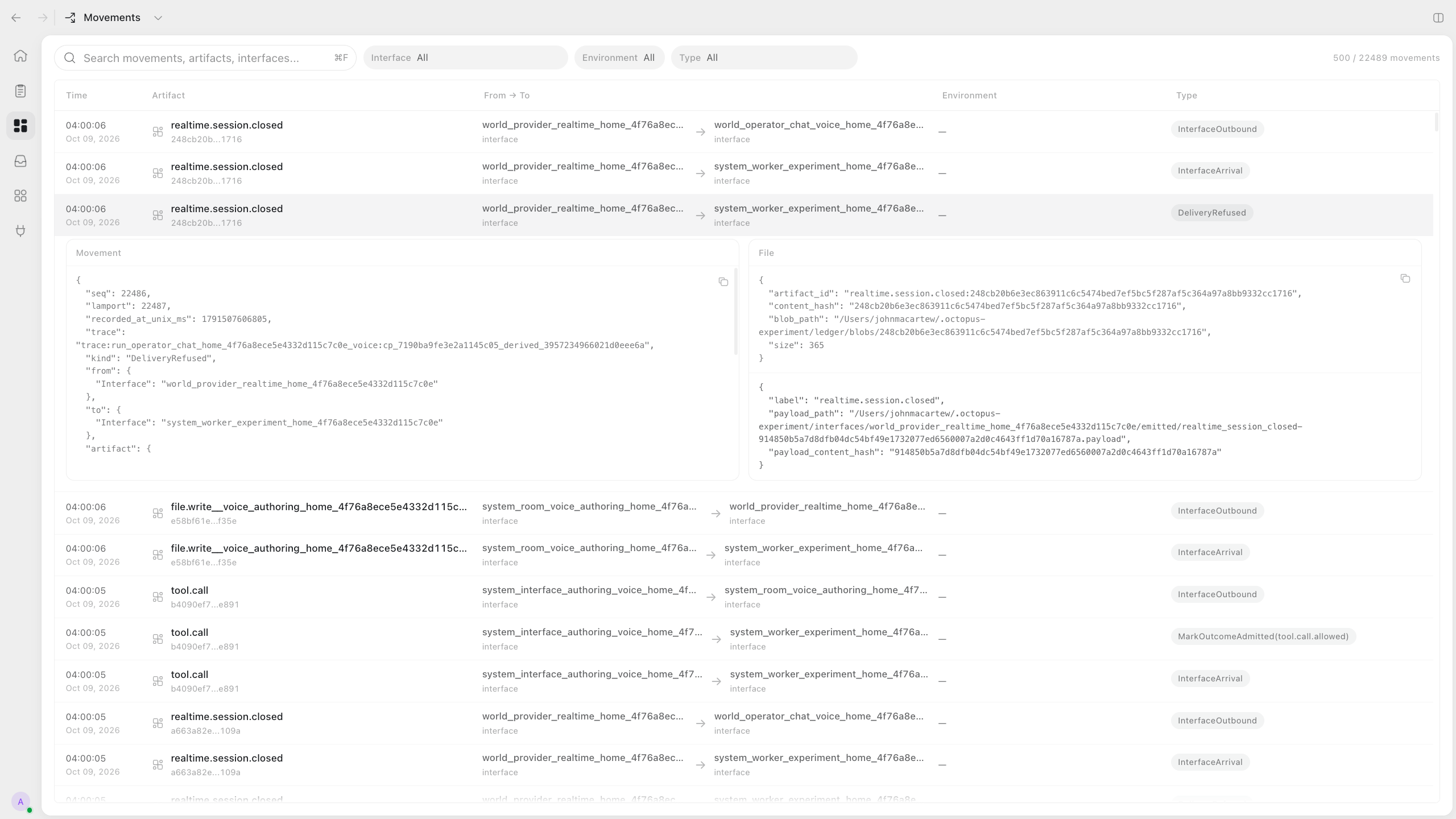
This is the visible counterpart of the payload, manifest, and metadata example. Another client can read the same ledger and indexes.
Indexes
Indexes make the log fast to query. They never replace it. The design copies how an operating system holds indexes: the kernel keeps in-memory caches over the data on disk, rebuilt at mount and updated per write, and the searchable index is a separate, disposable file beside the data. A database is a userspace application on top of the filesystem, never part of the kernel.
Layer 1 - the kernel index
In memory, read-through. The arrival path’s idempotency questions - has this exact checkpoint generation already closed its required set, has it already admitted this exact artifact, is this arrival already recorded - are answered from an in-memory projection of arrival rows.
A checkpoint generation is (run, checkpoint, epoch). A generation without
requirements is a standing route: it admits each distinct artifact once, keyed
by generation and artifact id, and is never re-armed for the next arrival. A
generation with requirements is spent when its set closes; re-arming it
requires a new checkpoint id or a new epoch. The index holds a watermark and catches up
incrementally before answering: the first question after boot folds the whole
ledger once; every later question folds only the delta. No arrival ever rescans
the biography of the world.
- One index pairs with one ledger for the process lifetime. A shrunk or non-contiguous log is a typed refusal; an arrival never answers from a phantom cache.
- A required arrival counts as admitted only when one exact, causally later
MarkOutcomeAdmittedproves it. One mark proves one pending arrival; indistinguishable pending arrivals fail closed instead of sharing proof. - Kernel decisions consult this layer only. Never SQLite.
Layer 2 - the Spotlight index
ledger/ledger-index.sqlite, beside the log. One row per movement, with no
payloads - the sequence number addresses the authoritative line. Indexed by
run, endpoint, owning interface, artifact id, admitted mark, and kind. WAL
mode: one writer, any number of readers.
Who it is for - readers, in any language:
- an interface catching up on its movements from its own cursor, as one indexed lookup instead of parsing the whole log. The cursor itself stays the interface’s own file; it never lives in the index.
- the client, rendering run summaries and movement history.
- a Python or JavaScript process, which opens SQLite natively.
What keeps it a cache:
- Disposable. Delete the file and nothing is lost. The next boot verifies the cache against the ledger and rebuilds it from zero on any mismatch. A different schema generation is dropped, never migrated.
- Never blocks the ledger. If ingest fails, the writer stops touching the broken cache, the arrival and its append proceed, and the next boot rebuilds. Fail-closed for truth, fail-open for cache.
- Never consulted for a kernel decision, and never written except as a projection of rows already appended.
Provider recovery validates movement projections before selecting complete grants. Writer history uses the SQLite edge index to locate its declared call and result transfers, then verifies their bytes, grants and ordered preimages against the ledger. Selection includes transfers missing runtime metadata so they still fail validation. The indexed boundary is checked against the log; an unavailable or unusable index reads the authoritative prefix, and later rows are read from that boundary. Complete grants are materialized only for the writer’s own call and result edges. The provider handoff and its authoring-result consumer share one writer-history cache for the same interface and ledger. Result consumption validates that identity and checks the appended delta against the retained cursor. Retained delivery uses a read-only projection for its emitting interface. Its reader checks every ledger row’s JSON and sequence, then decodes only that source’s movements. Selected required arrivals keep complete grants and exact mark and replacement proof; other interfaces’ grants are outside this projection. The projection accepts only its source and increasing original sequence numbers, and exposes retained-delivery queries, not kernel admission decisions. The kernel’s complete arrival index is unchanged. Other recovery readers validate their selected referenced grant content without copying unused authority into every historical movement.
Caches over the JSON on disk
The ledger is one truth surface. The descriptor and run JSON on disk is the other, and the same discipline applies: the arrival path answers from an in-memory projection refreshed only where a file changed.
The run-record index. A reverse map from interface folder to the active checkpoints that pin it. Before resolving targets, the index compares each file’s identity, size, modification and change times. Settled, unchanged files reuse the parsed record and routes. Only changed or recently observed files are reread; equal bytes avoid reparsing. Vanished files are dropped. Malformed or unreadable records contribute no targets, while healthy siblings continue. Admission still reads the chosen run and forms its grant from current data.
When a run file changes, already-admitted outputs for its newly visible bindings are replayed through the ordinary per-edge gates. A repaired recipient catches up while the runtime stays up, with no resend, no poller, and no delivery queue.
The registry snapshot guard. A walk folds paths, metadata and cached content
digests into a fingerprint. Changed files and files with recent or unusable
timestamps are reread; settled, unchanged files reuse their digests. Cache age
alone cannot change the fingerprint. Parsing and validation run when the
fingerprint changes. Before/after
observations must agree. Unreadable or stably malformed descriptors fail closed;
concurrent writes return RegistryUnstable.
Retained delivery preserves that typed refusal, the artifact and delivery identity.
It does not repeat the producing effect. Policy refusals remain terminal.
The one-second freshness window covers equal-size writes within a coarse filesystem clock tick. An observation must already be settled before reading: a cached recent observation cannot become reusable just because time passes. Missing or future timestamps cannot establish freshness. Platforms without a change timestamp keep the read path. Context-artifact materialization follows the same rule before reusing its canonical blob.
Restart
A run is rebuilt from its record and the movements recorded against it. A stopped process loses no state.