Contracts
Environments
“Environment” means two different things in Octopus. They are not interchangeable and they do not nest under a third concept.
| Execution environment (EE) | Worker environment | |
|---|---|---|
| Answers | Why, and what is allowed | Where the effect physically happens |
| Owns | Goal, policy, place in the hierarchy | Executor, tools, sandbox boundary |
| Declared in | registry/ee_template/ |
registry/worker_environment_kind/ |
| Lives as | state/ee_instances/<ee_id>.json |
A leased room behind a door interface |
| Needed | Always - every run lives in one | Only when tools must act on the world |
The semantic axis: EE
An EE is a scope classified by a goal. The system is defined by the full set of EEs it can act in.
- Template -
registry/ee_template/<id>/ee_template.json. Declares the goal class, the interface allowance (which includes worker pins), allowed room kinds, optional tool narrowing and hard blocks, the child templates that may be created beneath it, and the host slots its rooms may be given. - Instance - a JSON record with its stable ID, optional human-readable name, template, parent, goal text, and any further narrowing.
{
  "ee_id": "ee_project_df8954674cf6fca310f23412",
  "name": "Life",
  "template_name": "project",
  "parent_ee_id": "ee_existence",
  "goal": "Manage personal work and commitments",
  "config": {},
  "policy_narrowing": {}
}name, when present, must be nonblank. It is EE metadata, independent of the
goal, template and policy; ee_id remains the stable identity. The client writes
the Project name into this field when creating or explicitly renaming a Project.
Topology and Project lists read the EE record’s name directly. An unnamed EE is
shown by its ID, without borrowing a goal, template or presentation alias.
Environments form a hierarchy. An instance may have a parent, and policy narrows
inward along that chain. A parentless instance starts an independent chain. The
single bootstrap_root template selects the initial seed; other authored roots
inherit nothing from it. Creating or reparenting an EE requires a granted path
to its record. See Policy.
Reorganizing is JSON. Allowances name originals, and a task’s private
copies are admitted by them, so a narrowed environment can host real runs: a
memory service in memory_maintenance, a recurring line of work in its own
project. An environment that lists interfaces names every original a task
carries: its worker, provider and client, the rooms it uses, and the service
doors composition adds (system_service_input,
system_worker_memory_observer, system_context_memory_projection). Worker
templates that host a provider hold the first two in their ceilings, so a
task’s copies keep them when narrowed; a refusal names the missing original. A run lives in the one environment its record’s ee names; another
run moves it by changing only that field, and the new place applies from the
run’s next arrival.
Goals classify, they do not enumerate. The root goal is existence. The
registry ships templates such as operator_space, project,
operator_interaction, memory_maintenance, self_improvement. These are
registry entries, not reserved constants. One request stays one goal unless a
policy or outcome boundary shifts; the boundary follows the meaningful outcome,
not every step of a task.
One primitive for long-running and one-shot. An EE exists while its record and relationships exist. Stopping, deleting, or unlinking one is an ordinary authorized file change.
An EE boundary is a policy boundary first, not a directory or a process.
Creating a goal is a cognitive act inside a run, performed under policy. It is not a pipeline transition. When to split a goal and when to keep it merged is open research; the framework has to prevent useless infinite splitting while preserving real outcome boundaries.
The technical axis: worker environment
A worker environment exists only where a run needs tools that act on the world. It is the room those effects happen in and the thing that provides the tools. A run that only transforms an artifact - text in, audio out - needs none; it is just an interface.
It owns the executor, capabilities, the boundary ceiling, and release. It owns no goal semantics.
The registry ships these kinds:
| Kind | Room |
|---|---|
filesystem_workspace |
A real project folder, used directly. The default for local tasks. |
git_worktree |
An isolated worktree on its own branch. Chosen explicitly. |
process_session |
A persistent process with a PTY and a private workspace. |
browser_session |
A persistent browser. |
desktop_session |
Screen capture and input - computer use. |
container_session |
A container. |
remote_exec_server |
A remote machine. |
mcp_stdio_session |
A stdio MCP server. |
code_mode |
Script cells that emit nested artifacts. |
web_search |
Web search. |
audio_device_session |
Local audio capture and playback. |
system_room |
The system’s own files: run records, registries, artifacts. |
A project’s path is an ordinary host-slot binding. A standard local task works
in a filesystem_workspace whose root is the real project folder; nothing
requires a second checkout to read or change files. git_worktree is a
specialized room for isolation you ask for.
Three parts, one code-world
A worker environment is exactly three parts:
- the kind - the executor that defines the possible tools;
- its door interface - the System interface a tool call is sent to;
- the policy the runtime forms to materialize it.
Its conceptual boundary is the code-world. The kind’s executor, its tools, and its door live in one language, one process world. A tool’s code belongs to the same code-world as its kind’s executor - never to the interface that asked for it. Only artifacts cross out.
That shared code-world is why the worker environment is a separate primitive, and it is what makes polyglot rooms possible: a Python scraping room is a Python kind, Python tools, and a Python door. The runtime does not know and does not care.
A kind’s code lives in its own folder,
registry/worker_environment_kind/<name>/packages/. Each kind runs its own
door and executor processes; code is reused between kinds by explicit import
from the owning folder, the same way interfaces reuse driver code.
A kind’s folder name is the name of an execution-code type, not a routing id. Artifacts are delivered by interface id; nothing routes by a kind name.
Persistent command control
The workspace keeper retains invocation and exact per-call results outside the
command’s filesystem scope. Its process descriptor may explicitly grant
allow_process_signals to the trusted executor. On macOS this permits signals
across sandbox labels; the default is false, and a copied descriptor cannot add
that authority. Command arguments still cross their own formed sandbox before
execution and do not inherit the executor’s signal authority. Command control
accepts an opaque process identity belonging to the formed WorkerEnvironment,
never an arbitrary host PID supplied by the model.
Private tool copies retain their authored authority. A distribution release with an incompatible contract requires fresh composition in a fresh Home, without rewriting existing copies or accepted invocations. No already accepted invocation gains new rights.
A failed stop retains the process handle and reports the actual error. Closure requires observed exit, stream closure and termination of the owned process group within the declared cleanup timeout; a deadline or permission failure never synthesizes an exit. A successful retry clears the current termination failure only after closure, while earlier call receipts remain unchanged. Replacing a package does not change the sandbox of an already running keeper. A keeper creates only its own record directories inside a process registry that still exists; once the Home that owned it is gone, retiring a closed command fails instead of recreating the tree.
A path outside the formed roots is refused as a boundary violation. A filesystem failure inside them (a missing file, a permission the operating system denies) names its operation and path instead, so it never reads as a policy refusal.
On macOS, the executor observes root exit without reaping its PID until the owned group has finished. Signals and reaping share that ownership; after it is released, later control cannot target a reused numeric process identity. Root exit remains distinct from closure, including a PTY whose streams close while another group member is still running. Observation and cleanup failures remain visible and never become successful closure.
Linux process authority
The Linux backend enforces process authority through an AppArmor profile before exec. The platform service owns only profile loading, child attachment and profile release; it runs no tool command and changes no command’s Unix credentials. Its peer pidfd and temporary ptrace hold bind attachment to the preparing process or its actual child without a recycled PID. A process already confined by Octopus can prepare another profile only with declared sandbox-delegation authority. Another user namespace cannot reach that delegation. Exact file grants include the publication protocol’s bounded metadata filenames, without granting adjacent files. Before exec, the native launcher prepares the exact ancestor and publication directories as the ordinary user, without following symlinks; the profile grants reads and locks without making those parents writable. Preparation can leave created directories if a later setup operation fails. Workspace commands use an unprivileged entry point of the same platform component and receive a new profile over their formed roots, protected subpaths and network ceiling. They receive no sandbox-delegation authority.
Preparation ownership and cgroup population retain the profile independently of the launching process. A surviving keeper therefore keeps its confinement; release requires both a closed preparation and an empty cgroup. Platform-service restart retains those cgroups and profiles and recovers their own records. Unavailable enforcement refuses launch. Full-host and explicitly disabled sandbox modes keep their existing semantics. Installation and requirements are described in Process isolation on Linux.
Choosing a room
Selecting a room is the intersection of four explicit links:
- the run’s formed grant contains the kind;
- the tool descriptor names the kind;
- the exact door interface belongs to the kind;
- the tool’s process binary is owned by the kind.
Zero candidates or more than one is an error. There is no hidden default.
A kind never enumerates the workers allowed to use it. It requires explicit consent, and a worker grants that only through its own ceiling.
The boundary can only narrow
A kind declares boundary_defaults: the sandbox ceiling for its rooms -
read roots, write roots, protected sub-paths, a network ceiling. Policy can
narrow that boundary. There is no operation that widens it.
Roots are symbolic slots such as repo_root or worktree_root. They resolve
from two layers of plain JSON, no code:
host.json- this machine’s defaults for every declared slot. One file per machine, for all doors.- The door interface’s own folder may override any slot for one instance. Ten sessions are ten folders, each overriding only what differs.
The runtime never reads these as a decision surface. The door resolves them as data.
The path is the permission
Access to a directory is the right to change its files. This is how run-state and descriptor changes work without any special machinery: to let a run edit its own record, an EE’s JSON, or a registry folder, policy grants it a room whose path covers that file. The edit is an ordinary file tool call - gated, recorded, and executed like any other.
A door’s host-slot override carries path and may declare additional_paths.
The primary path remains the working directory. Additional paths extend that
same symbolic slot to an explicit set of roots; they never grant their common
parent. Process authority, filesystem boundaries and protected subpaths apply
to every root under the slot’s existing grant. The formed record retains the
additional bindings and includes them in its formation pin; a lease refuses a
different set. Empty additional bindings are omitted, preserving existing
single-root records and their pins.
Fail closed
- A malformed EE or template identity fails before any state is written.
- A missing EE on a live run is an error, not an invitation to mint a default.
- A room whose kind requires release will not open under a driver that cannot provide the release hook.
The authoring guide is registry/worker_environment_kind/GUIDE.md.
In the app
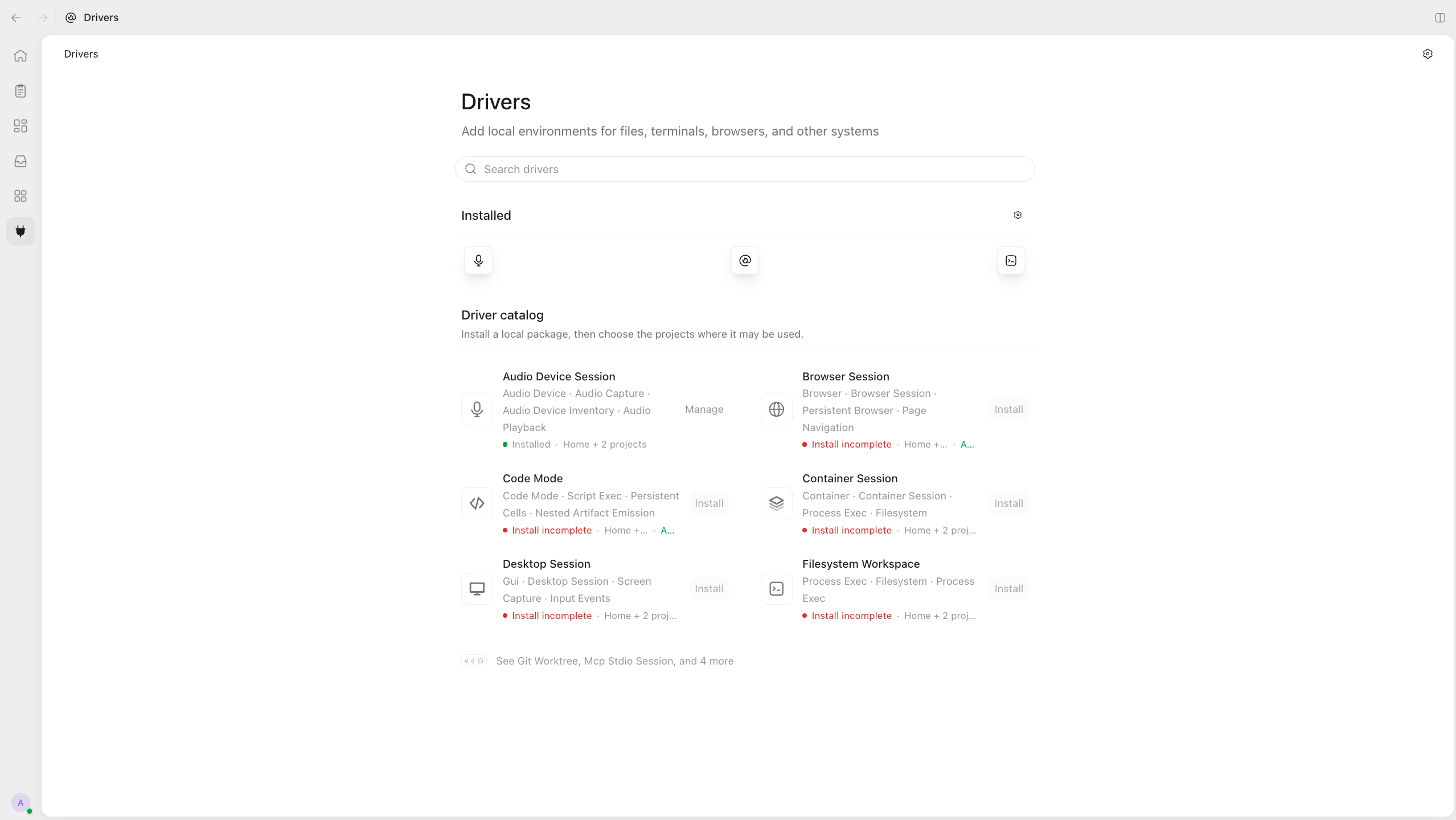
A Project is an EE. A Driver is a worker-environment kind the operator can install and make available to a project. Installing its package does not create a room or grant its tools to every run. A task obtains an environment through its kind, door interface, and formed policy.
For example, Filesystem Workspace supplies tools in a chosen folder; Git Worktree supplies an isolated checkout. Files, Terminal, and other task panels reflect the actual environment’s capabilities. These are choices made by the optional desktop client, not extra runtime primitives.