Contracts
Extending Octopus
The cookbook for adding capabilities without editing the runtime.
It should work like a package
Adding an interface, a worker, a tool, a verifier, or a room should feel like dropping in a portable bundle and editing a few JSON bindings. “Package” is a distribution layout, not a runtime primitive. Once loaded, the runtime does not reason about package identity. It sees ordinary descriptors, exact interface folders, bindings, artifacts, policy, marks, rooms, and runs.
For an existing family, a new Telegram-like channel, provider, or worker preset is descriptor and binding data. If adding one channel requires editing app bootstrap, session logic, or a manager named after the concept, a primitive has leaked.
If a genuinely new execution family is missing, add that family once as code inside its owner folder. Every later instance of it is data.
Installed owners may contain authorized local edits to descriptors, role artifacts and executable code. Health checks validate their identities, structure, declared imports, client APIs and diagnostic probes; byte equality with a distribution or an installation receipt is not a health requirement. Receipts retain installation provenance. Content digests remain appropriate for immutable artifact references, release integrity and concurrent-edit protection during publication or removal.
Octopus is a research preview. Incompatible persisted formats require a fresh Home through normal setup. There are no schema migrations, predecessor tables, automatic package adoption, or startup repairs of missing fields in old state. The bundled registry initializes a new Home once; later starts use the installed registry. Explicit package installation and recovery of interrupted operations in the current format remain supported. Preserve sign-in credentials when resetting a disposable Home; do not transplant old runs, checkpoints or ledgers.
Interface process lifecycle
Life reconciliation caches resolved configurations and executable digests using file identity, size, modification and change times. Cold resolution shares the same digest cache; content fingerprints include the checked executable digest instead of copying its bytes for each bound interface. Reconciliation yields between interfaces and observes shutdown before lifting further lives. A metadata observation less than one second old is racy: only that file is read again, so equal-size writes within a coarse filesystem clock tick cannot reuse stale content. The observation must already be settled before the read starts; a cached racy observation never becomes reusable merely because time passes. Missing or future timestamps keep the read path. Platforms without a change timestamp also keep that path. Build receipts still check the executable digest, and changed content participates in the life restart fingerprint. Cache age alone cannot change that fingerprint or restart a process. This is freshness and receipt consistency, not a security boundary against an actor able to replace both executable and receipt.
The generic Rust life bridge acknowledges readiness publication. Awaiting its ready signal succeeds only after the bounded Ready frame has been written and flushed; synchronous recovery work after that boundary cannot postpone the publication. Cancellation, a closed publisher, or a write/flush failure remains an error. This acknowledgement covers readiness publication, not completion of pending artifact deliveries or recovery work. An in-process life signals its readiness observer directly.
The life host observes root exit separately from group closure. On macOS it
keeps the root waitable until the owned group closes, so cleanup never signals
a recycled PID or PGID. Protocol EOF allows a bounded exit observation; process
cleanup and private stderr draining also have finite deadlines. When the root
exits first, the host closes its group and reads the protocol output to its end
before it judges the exit, so every frame printed before the exit counts, the
asleep frame included; output that stays open past the cleanup deadline after
the group closed fails the life. Wait, signal and
cleanup failures remain explicit, with the original exit status and private
diagnostics preserved. Each incarnation writes its own bounded stderr capture
in the interface’s var directory; the host keeps the sixteen newest, so a life
that restarts with backoff for days keeps its recent history without filling
the disk. Older captures are retired before each incarnation starts; one that
cannot be retired is reported in the runtime log and does not stop the life.
In the client
Conversation pane tabs, selection, visibility and layout are client-local state,
scoped to the Home, access profile, client window and conversation. Navigation
restores that conversation’s state without writing it into a run. Reading or
opening a task does not change its position in the normal last-update order.
Creating or explicitly renaming a Project writes name in its EE record through
the guarded authoring transaction. Topology and Project lists read that record;
the presentation sidecar’s name is only a mirror. Goal and template remain
separate fields, and an unnamed EE is shown by its ID.
Composer dictation is client-local preparation. Live speech is streamed to the client’s transcription provider and appears as a transient editor preview. Only finalized text enters the persisted draft. Completed and cancelled audio is saved by default under the selected Home’s client data, separated by access profile, with a bounded history of 20 recordings. Voice settings show that history inline under Dictation: transcript, timestamp, Copy, Retry for audio without text, and a Download/Delete menu. Composer failure recovery opens the exact recording in these settings. Stop finalizes recognized text; the Send arrow finalizes and submits it through the declared operator interface. Escape cancels capture or a pending transcription while preserving manually typed text. Transcription failure retains its audio for explicit retry; it does not silently switch recognition paths.
Project source folders are ordered client configuration in the EE’s
config.octopus_os.source_folders. The first folder is Primary. New task
composition binds that folder and the remaining explicit roots to the selected
workspace door, and carries their names in the operator input’s client context.
Full access keeps the same working context while its separate host-root grant
controls filesystem reach. Full access is the default for a new task unless
the EE’s config.octopus_os.task_access_default is project_access; a room
holding the host root runs its commands without a platform sandbox. Full
access binds the host root to every selected Worker Environment that declares
it. Full access with none of them selected is refused, never narrowed; an Agent
without such a Worker Environment starts in project access, shown as such. Editing project folders affects future tasks;
existing private doors retain their accepted roots. Folder edits and presentation
are one guarded client transaction whose receipt proves the exact EE writes
and Home-sidecar publication.
An operator message rejected during preparation is explicitly not_sent.
The client restores a manual message to the composer and reports the error
through its existing error surface. An uncertain delivery is reconciled against
admitted message identity; an explicit retry retains that identity. It never
retries automatically. A newer draft is preserved, with the failed message kept
in durable client storage until it can be restored or explicitly handled.
Provider turn boundaries also split the visible history when another run starts
a new turn, so an earlier answer cannot hide later activity.
The native client checks the selected Home’s writable storage before sending. Below 16 MiB available, a native ENOSPC/EDQUOT refusal, or an unsuccessful write probe blocks new sends with a visible explanation. The composer keeps its current draft in memory; failed disk persistence explicitly asks the operator to keep the window open. Queued messages do not dispatch while storage or their exact provider life is unavailable. Observed life failures are presentation state, not fabricated run status or ledger evidence.
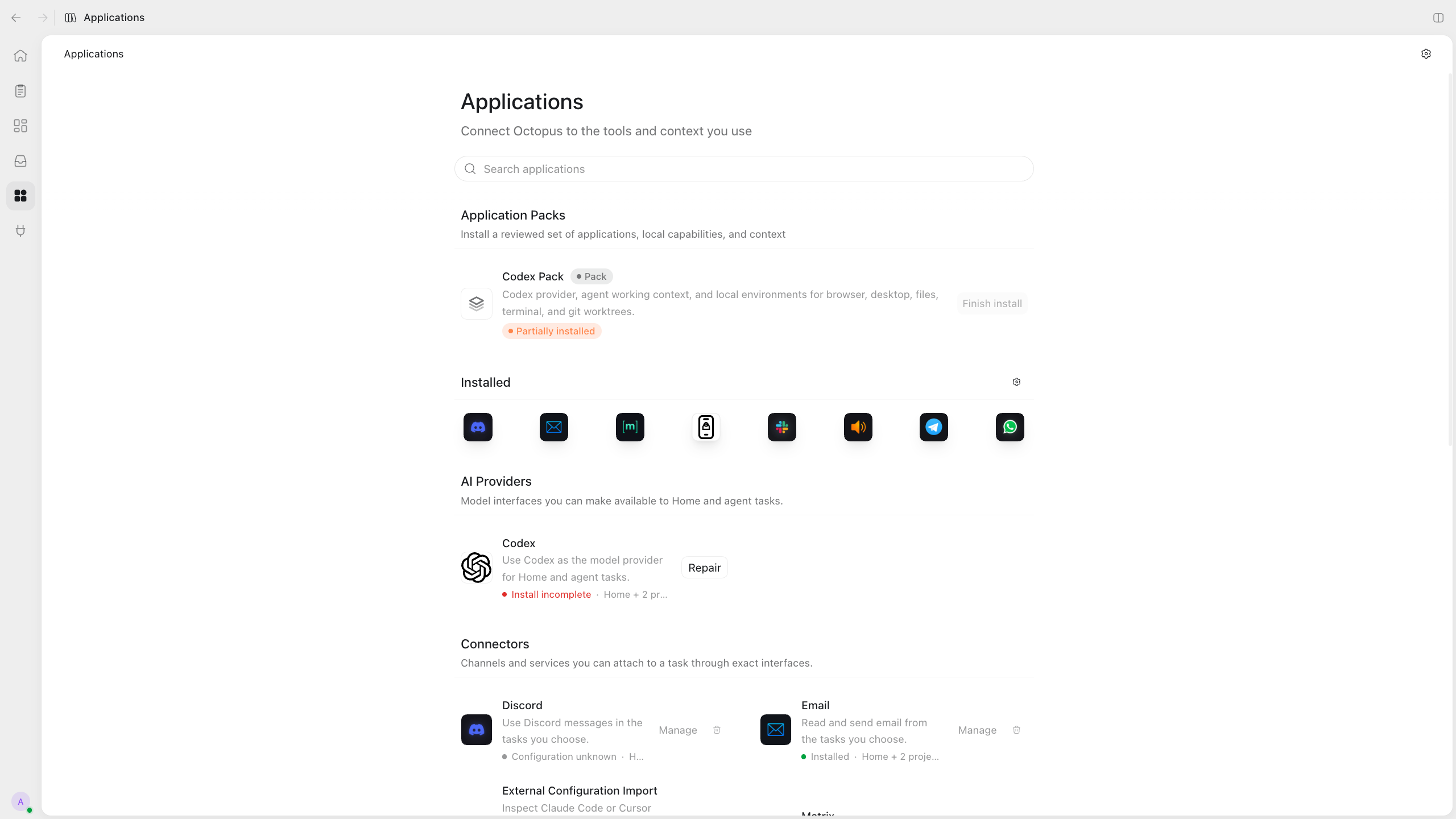
The optional desktop client’s Applications catalog presents these packages
as providers, connectors, plugins, and context artifacts. A connector such as
Slack installs interface files; making it available in a Project and connecting
it to a task are separate steps, and only connected tasks receive its messages.
Photos, screenshots and image attachments arrive inside the message artifact,
so the model sees them as images. What a connector can do (post, reply, edit,
react, upload, read a thread) is its operation catalog, the same declaration an
MCP application uses: one JSON file per action under operations/ with its
input schema and description. The model calls each action as its own tool, and
the connector answers each request exactly once on its result label, with
images it read as media; an action whose outcome is unknown after a restart
is reported as indeterminate_external_effect, never repeated.
A plugin is a service the model calls through its interface, such as an MCP
server, together with the context artifact that teaches the model its contract.
Installation does not make the model call it automatically. An application pack groups packages for setup without
introducing a new runtime identity.
Connect is the client’s own setup step, like signing in to a provider. An
interface can declare a connection module under its packages/ folder in
private_config.client_connection; the client runs its probe, connect and
disconnect to check what you enter against the real service, show the
connected account and walk you through browser sign-in or pairing. A module may
live in a family owner’s folder when that owner declares it, as its own module
or in its family_modules; the Application’s package then names that owner’s
package in required_packages, so installing it installs the module. The MCP
client package owns two such modules: connection.cjs for servers reached with
a key or OAuth, and chatgpt_apps.cjs for apps linked to the ChatGPT account,
such as Gmail, GitHub and Google Drive. Each ChatGPT app declares its connector
as data in private_config.connector_link: the connector id, the slug of its
ChatGPT apps page, and a read-only profile tool with the email or login field
that names the account. An application on connection.cjs names its account
through private_config.account_profile: an MCP resource that lists accounts,
or an https request to the service’s own API that verifies the key. Each
connection check opens its own MCP session and ends it with HTTP DELETE.
Applications without a module are connected once their required setup fields
are saved. The account a module shows is the service account the application
works in, such as the Gmail mailbox; the sign-in it is reached through, such as
the ChatGPT account, appears only as its detail. A bot connector shows the bot
as its account (the Telegram bot’s @username, the Slack bot and its workspace,
the Email mailbox). When the service is the ChatGPT account itself, as for
Image Generation, the label is that account and the detail is its ChatGPT plan.
A module reads each value the way the interface’s life receives it: a value in
the launch environment wins over the saved one, a different saved value is an
error, and Connect does not save a value the environment already supplies.
Disconnect returns the state that actually remains and names what still grants
access. A module may also return a
manage link (a label and an https address) to the page where that account is
managed, which the client offers in the connection menu. The
connection check is presentation only: the interface still refuses to work with
bad credentials, and nothing is recorded in a run or the ledger. For an MCP
application that declares server_tool_operations, Connect also turns each tool
the server lists into an operation of that application, keeping the server’s own
annotations (readOnlyHint, destructiveHint and the rest) in the operation.
Every Connect of an application with operations, and every publication of a
server’s tools, rewrites its operation catalog artifact
(artifact-operation-catalog-<interface>) from the whole operations/ folder.
Connected tasks bind that catalog, so the model sees each operation as its own
tool — including tools published after the task was created. A task cannot be
composed while the catalog is missing, so the check reports an application whose
service is linked but whose catalog was never written as not connected, and
Connect writes it.
A Project task, an Agent and Home are offered an application only when their
worker pin’s ceiling holds it: every interface the application names, and each
declared task capability’s tool, owner interface and Worker Environment kind.
Nobody keeps that list by hand: installing, removing or repairing a package
writes all of that for every installed application into the ceilings of the
worker pins their packages mark application_host, and takes out what only
removed applications declared; what the host’s own source policy grants and
entries no application declares stay. Installation writes into no other worker
pin. Every worker a pack offers as the Home worker, the task worker or an Agent
preset source is such a host — the Home and task workers of Octopus Home and the
Computer Use worker of Desktop Session. A host whose installed receipt predates
its package’s configuration contract refuses every package operation before
anything changes; that Home is initialized fresh. Making an application
available in a Project admits it within the EE chain and never widens a worker
pin. An application the Project admits but the worker’s ceiling does not is
listed in the Agent dialog, disabled, with that reason. An Agent’s pin is a copy
of its source worker pin; saving the Agent re-forms its policy.json from that
source, so a widened source ceiling reaches an existing Agent on its next save
and never through any other path.
Connected tasks share the application’s one interface: one life, one session,
one set of credentials. An operation call goes from the task’s provider to that
interface, and its result reaches only the calling task: the call arms a wait
for exactly its own result — the same operation, correlation id and the result
label the catalog declares — checked by the tool_result_correspondence
verifier. The interface’s private_config.task_input_labels lists what a
connected task receives unprompted, such as a connector’s incoming messages;
those start a turn, and nothing else from the interface reaches the task.
Interfaces that receive such events are never copied privately, so one poller or
socket serves every task.
Approval follows the task’s access, as in Codex. A Full access task carries
approval_policy: "never" and no tool asks. A Project access task carries
"on-request": a server tool then waits for your approval unless the server
declares it read-only, or neither destructive nor open-world. The application
answers such a call with an approval request instead of running it; the chat
shows Allow once, Decline and Cancel. Your answer is checked by the
operator_approval verifier against that exact request and recorded in the
task’s evidence, and only then does the application send the call; a declined
call returns operator_declined to the model. The call’s wait stays armed until
that final answer arrives. The same rule covers the generic call by tool name. Other calls of
the same native turn keep waiting or settling while one call waits for your
answer.
A configured local Home opens after local client unlock and verification by the existing setup owner of its complete aggregate receipt, followed by matching that receipt’s operation and workspace request to the workspace receipt and visible Home scope. A directory, running process, or worker is not setup proof. The completed branch does not request the setup model catalogue or require a fresh provider account observation; a browser setup draft does not supersede the completed receipt. New and incomplete Homes still require the real provider account and all setup proofs. An unavailable account observation is distinct from a confirmed signed-out account and never becomes authenticated state. Changing the selected Home discards pending client proof and account observations from the previous target and validates the new target. This local shell admission does not authorize provider requests: sending and provider-dependent operations retain their runtime authentication, bindings, and formed grants.
The client preserves native publication-selection evidence in task authoring profiles. Selected instruction artifacts remain independent bindings; publication provenance never nests them as instruction text sources. Task visibility uses the same sidecar contract as task creation. Communication activity resolves recipient names and navigation from the exact input interfaces on projected task records. Waiting for replies does not imply that those tasks are executing. A live event cache is partial until a complete history snapshot has loaded; opening a partial cache retains the loading state.
The desktop reads model descriptors independently of the task list and workspace transaction lock. Task projections inspect workspace receipts without recovering transactions; startup and the owning mutations perform recovery. A run changing while its snapshot is read invalidates the next read, without indefinitely restarting the current one. Registry and policy changes still require a fresh configuration snapshot.
Task lists read the installed descriptors and run evidence without auditing the package inventory. Package, application-catalogue, composer-capability and full-snapshot reads load that inventory when they need it, retaining its current integrity checks.
The desktop client may persist derived task status and text previews under
client/projection-cache/. A status checkpoint includes the exact movement
prefix, ledger identity, reducer version, provider and execution scope, input
protocol, and the identities of every verified artifact file it consumed. A
matching checkpoint folds only appended movements. Previews are keyed by the
exact artifact and read contract. Changed source files or contracts invalidate
the result; malformed caches are discarded with a diagnostic. Cache write
failure never blocks an authoritative read. These files are disposable client
data: runtime admission and policy never read them, and removing them changes
only the cost of reconstructing the same result. Changes to the fold or preview
semantics require a new cache version.
Editing the latest idle operator message sends a new operator.message artifact
with replaces_message naming the exact admitted input. Its original attachments
and task bindings remain in place. The provider selects the conversation prefix
before that input, records interface.context.updated with phase=message_revised,
and starts a fresh private model context for the revised history in the same Run.
That revision participates in the provider’s context identity and is replayed on
later turns and restarts. The client replaces the displayed turn only after the
provider receipt; older messages remain in the immutable ledger. This does not
undo tool effects. Concurrent work, an older input, or changed attachments refuses
the edit. Payload selection updates retained future tool routes together with
their templates, while pending effects and foreign-owned bindings remain exact.
Assistant display edits are client-owned documents at
client-state/workspace/assistant-text-edits/<run-id>.json. A version-1 document
contains run_id and edits; each edit names provider_interface, turn_id,
item_id, original_text, replacement text, and edited_at_ms. The client
matches the exact task, provider, turn, item and original text, applies the edit
after reading history, and retains it across duplicate deliveries. The answer is
marked Edited, with the original text available on hover. Removing the edit
restores the original display. These edits do not change model context, artifact
identity, tool evidence or the ledger. Ledger rows must never be rewritten to
edit a displayed answer.
Client authoring receipts prove completed file publications, not the continued immutability of live runs or descriptors. Recovery checks the retained native operation result and never republishes an applied write over later work. Preimage checks protect new writes and rollback; read-only source observations are not writes. Suggestions and task naming bind their admitted source artifacts and leave the source run outside their write set. Shell admission reads the workspace identity without replaying unrelated client transactions.
Client suggestions and task naming use a client-maintenance EE that is a separate root beside the workspace’s initial EE. Its template and worker ceiling grant no tools or worker environments. The client projects projects and tasks from its workspace subtree, so this service is outside that projection. The owning package authors the root when preparing maintenance work and rejects an existing maintenance EE with a different placement.
Task naming uses a separate client-maintenance run with private input, result, worker and provider interfaces. The provider copy retains the task’s selected model, reasoning effort and service tier. Its request binds the exact admitted user artifact and declares a text field, instructions and output schema; the native provider generates from that input in an ephemeral context with no tools or worker environment. The result crosses the private return interface as an artifact. The client writes a valid title into the task’s presentation only while no authored name exists; a local manual alias also takes precedence. Generation does not hold the task’s execution lock. Completion or a bounded failure removes the maintenance run’s active bindings, and an uncertain native request is never silently repeated. This operation currently requires a native Codex binding; other provider bindings do not claim title-generation support.
Deleting a task includes its exact client-owned suggestion and title runs and private ports under the same retirement proof as its other owned records. The client checks each companion’s source, topology and descriptors. Shared dependencies still refuse deletion; ledger evidence and published shared memory remain. The task’s declared input intake and writer belong to this inventory even without client presentation sidecars. Idle clients’ declared output routes to the task and exact policy allowances for its private resources are removed in the same guarded transaction. A required wait, ambiguous owner or busy connected client refuses deletion. Run-coordinate context artifacts remain readable provenance; their recorded coordinates are not live bindings. Publication metadata directories are checked as private storage and never treated as descriptors. While native ownership is held, repeated retirement checks reuse only the verified ledger prefix. Its bytes and every referenced grant remain checked; new rows are decoded and cold recovery validates the complete prefix again. Runtime-private directory contents are pinned after held quiescence, including the runtime’s own process-finalization writes. Their root identity stays fixed; public descriptor trees must still match the original staging snapshot.
Context-free outgoing connections are future routing configuration. The provider may recognize their exact addition or withdrawal between checked writer records; withdrawing a connection requires a terminal handoff that does not use it. Its checkpoint, frontier references and template are removed together, while context, history, ownership and pending effects remain identical. Recovery still proves every other edit through the declared writer chain, including consumption of a completed tool result before the routing change. A routing edit never substitutes for a writer receipt or grants a future emission.
Drivers package worker-environment kinds. Client Extensions instead add widgets, tabs, inputs, and guided repairs to the app. Use those when extending the presentation; use the recipes below when extending what the runtime can do.
What takes what
| You want | You add | Runtime code |
|---|---|---|
| A model provider OpenCodex can serve | One entry in the OpenCodex bridge’s providers.json; scripts/sync-providers.ts writes its folder and local package from the Codex template and the pinned OpenCodex registry; a provider served by the vendor’s signed-in CLI declares cli (its commands, home paths and bridge environment) instead of a key |
None |
| A provider over another existing wire | One interface folder: interface.json + life.json importing the wire owner’s driver, with its own transport config |
None |
| A provider over a new wire | Driver code inside the interface folder that owns that wire, then the folder above | None |
| A channel, sensor, or service | One interface folder, with a process if it must listen | None |
| A worker | A copied system_worker_<name>/ folder: new id, edited ceiling |
None |
| A goal | An ee_template folder |
None |
| A tool over an existing room binary | A tool.json with its handler_config |
None |
| A tool with new behavior | A binary in the owning kind’s packages + tool.json |
None |
| A room over an existing executor family | A worker_environment_kind folder + a door interface |
None |
| A genuinely new kind of room | Kind-owned package code first, then the descriptors | None |
| A check | A verifier folder: descriptor + script |
None |
| An outcome | A mark folder, then allow it in a worker’s ceiling |
None |
| A role, grounding text, or skill | An artifact folder, then bind it on a checkpoint |
None |
| System data kept on screen | A feed interface folder without a life, a run that emits into it, and a client Extension that reads the feed | None |
The last column is the point.
In providers.json, an explicit models list supplies the model catalog even
when registry_entry supplies upstream transport defaults. Keep model additions
in that list and regenerate the descriptors so the build preserves them.
Where code lives
Every executable file belongs to a concrete owner folder:
registry/interface/<id>/packages/- an interface’s folder name is its routing id;registry/worker_environment_kind/<name>/packages/- a kind’s folder name is the name of an execution-code type; nothing routes by it.
There is no neutral shared code home between owners. An owner reuses another owner’s code by importing it explicitly from the owning folder. The import creates no shared identity, no family admission, and no policy surface.
What is never shared is the live executable: each kind runs its own door and executor processes. Byte-for-byte clones of code per owner are not the model either. Import is.
On macOS, the process sandbox permits read-only operating-system runtime resources, including ICU locale data, alongside system libraries and timezone data. Application files and credentials come from the process authority declared by their owner.
A process selected through the developer-directory shim (git, python3)
uses the system selection returned by xcode-select --print-path, including
macOS’s default selection when no explicit selector symlink exists. Authority
formation resolves xcrun --no-cache --find against that directory and pins
the same DEVELOPER_DIR for execution, with xcrun_nocache=1 and exact read
access to its selector library and SDK metadata. An unavailable selection or
a selected executable outside that directory fails closed. No system selection
is changed. Doctor checks life executables and their explicitly declared
executable paths and commands through the same runtime-closure resolver,
including lives without diagnostic probes; it does not execute a model turn
or establish that pending work can recover. A workspace command’s temporary directory is
/private/tmp when its sandbox may write there, otherwise its working
directory or another writable root, never /; a room that may write nowhere
runs its command with TMPDIR, TMP and TEMP unset.
The macOS desktop helper builds its pinned Swift package with SwiftPM sandboxing disabled. This avoids nesting SwiftPM’s manifest sandbox inside the caller’s existing process sandbox; the caller’s declared filesystem, network and process restrictions remain in force.
read_executable_relative_paths declares read-only runtime resources relative
to the parent of a resolved executable, after following its symlinks. Each entry
names an executable already in executable_commands and a relative path; a
missing path fails authority formation. For example, a Python verifier declares
{"executable":"python3","relative_path":"../lib"} for its installation’s
standard library. The host resolves paths without knowing the language or
substituting a different interpreter. Copies cannot add these read grants.
Add a provider
- Copy the nearest provider folder that speaks your wire, for example
registry/interface/world_provider_ollama/, toworld_provider_<name>/. - Set
idto the new folder name. - Edit
interface_driver_config: base URL, model, request shape, and the name of the environment variable that holds the key. Never the key. - Keep
life.jsonpointing at the wire owner’s driver (interface://<owner>/packages/...), and list any environment names the process may inherit. - Add the new id to the
ceiling.interfacesof the worker pins that may use it, and to any EE template that restrictsallowed_interfaces. - Bind it on a run’s checkpoints.
Nothing in the runtime changes, and nothing matches on the provider’s name.
An admitted request that steers a native turn retains its exact input artifact
and emits turn.control.acknowledged with the new continuity. That receipt is a
declared context output, so the authored run advances with it before a later
tool result is consumed. A queue-only input receipt with no continuity remains
turn.input.acknowledged and does not claim a context change.
A tool, operation or operator result that settles one of several outstanding
calls of a native turn leaves the turn waiting for the rest. The provider then
emits interface.context.updated naming the awaiting_results with the new
continuity, so the run consumes that result and retires its result input before
the next one arrives; the last result resumes the model. Standing outputs the
waiting turn delivered without a write, such as a late usage update, belong to
that turn: the write of a result that continues it carries them along. A waiting result is
always consumed through its own admitted movement, in one write. Whatever checked
writer changed the run’s context while the call waited — sibling calls and
results of the same turn, a steer, a control receipt, an earlier turn’s
publication, an owner write — the consuming write records the context added
since the receiving checkpoint, in record order, as its rebase. Every checked
validator recomputes that rebase from the record before the write, and every
reader rebuilds the result’s session context as its admitted context, then the
rebase, then the result. Instructions, role artifacts and the sources an owner
input selected are not part of it: they stay static across a session snapshot,
and the native turn refreshes them. Context that left the run while the call waited, or
a change without checked writer evidence, fails closed. A result is never
delivered twice. A session snapshot the provider published while the call waited,
such as the closure of a sibling call’s late result, replaces the context it
carries: the rebase then starts with that snapshot, and every reader proves that
the snapshot carries the whole admitted context before building on it. Admitted
context that no snapshot carries has left the run.
The provider declares conversational input formats in private_config.input_messages.
Each label names the payload fields that carry its text, client observations,
attachments and request identity. An admitted message uses the same decoder when
the model is idle and when it is working; a follow-up reaches the current native
turn without waiting for its final answer. The original artifact remains the
reply reference through tool results and interruption. Labels and field mappings
belong to the provider package; the kernel continues to route by interface.
text_fields declares alternate text carriers; populated carriers must agree.
client_context_field, attachments_field and identity_field name their
payload fields, and identity_required declares whether the identity must be
present. context_fields names required accompanying data.
request_context_fields maps structured request fields to array or object;
when text is absent, nonempty declared request context carries the request. The
provider preserves the complete structured payload instead of selecting or
rewriting a transcript line.
An artifact from any other interface reaches the model as its structured
payload. When that payload carries media, the same entries a tool or operation
result uses — mime_type, the image’s own artifact manifest and its bytes as
payload_base64 — the model sees each PNG, JPEG or WebP image as an image, and
the payload text keeps the manifest and dimensions without the bytes. A
malformed or mislabelled image fails the input closed. This is how a connector
hands over the photos, screenshots and image attachments it received: the bytes
travel inside the one event artifact the kernel pins, so no task needs read
access to the connector’s private files.
Native user-input requests cross the provider’s declared question and answer artifacts. The client renders the question and returns the selected or written answer with its request identity; ordinary question-shaped prose creates no request. The authored answer wait retains the exact request artifact and the static context classification from the requesting turn, so responding after a restart can recover the same native request. If the native thread reports that the question’s turn was interrupted by process death, the provider proves its exact admitted question and verified answer, then resumes that thread through the existing interrupted-turn continuation path with the answer in context. It does not submit a reply to a dead RPC or replay an approval, elicitation or world effect. The operator application package supplies the verifiers for its answer and approval contracts. The bundled provider enables this native tool in default mode. Context usage is a provider observation: the client uses the latest reported context size and capacity, independently of cumulative billed token usage.
Capability amendments validate both the installed checkpoint frontier and the future checkpoints declared by the provider’s authoring topology. Candidate formation includes the final descriptor updates and mandatory role bindings for every reachable worker pin before any dependency or activation is published. A future route cannot enter the live topology with an unbound mandatory role and thereby invalidate the run’s existing input or control checkpoints.
A model amends its own run while its turn waits on that amendment call. The selection is planned against the frontier the turn will rearm, keeping the retained templates’ static context order, and rebased onto the current record: the pending effect and its checkpoints stay exactly as admitted, and only the template change and the new routes are applied. A result wait the same step opens keeps the context it captured; context the amendment adds reaches the model through the amended context route. The retained owner-input templates are not rewritten, yet every input that carries the provider context treats the static context the stable context inputs declare, amended included, as static. Every reader of that write, live or checked, validates the ordinary step the amendment carries as its own patch and the amendment as an exact transformation of it.
A model can also edit its run’s future contract directly. It sends the
content_hash its file.read of the run returned and an RFC 6902 patch of
that record, the same guard file.write uses, never the record itself. The
provider proves that hash names a checked state of the run, the patch applies
to exactly those bytes, and only the validated delta is rebased onto the
current record; a hash the run never had, or a patch that does not apply,
fails before any effect.
A change may remove a standing external input: a requirement-free stable input with no owner and no result receiving, such as a trigger the run no longer wants, whose interface keeps no other route or state in the run. The run’s worker, provider, authoring source, and any interface holding state in the run, such as its own client with its message and control routes, are never removed this way. The input’s template, checkpoint and frontier entry leave the run in the same checked edit, so that one run stops receiving the trigger while every other run pinning it keeps it. A context-carrying input can be removed only while another input still carries the run’s context. Removal does not withdraw what the input already admitted: the turn that arrived through it, including the turn that removes it, and any arrival admitted before the edit settle against the record pinned at their arrival. Every other retained selection entry stays. Static context a change adds reaches the run’s context and the tool outputs the run arms, including outputs armed while the turn waits; a tool route whose call is still pending is armed again only after that call settles, even when the change extends its tools, so the pending call is never admitted twice. A context-free input and an input another owner writes keep the static artifacts they were accepted with, so an arrival they already admitted keeps its exact checkpoint.
Authored run previews and publication plans also validate the complete candidate against each bound provider’s declared authoring profile. They use the provider owner’s topology validator, including its frontier and future checkpoint templates, before publishing any files. The model receives the validation verdict, regressions and remaining issues without repeated registry snapshots. This checks declarations and formation; it does not establish that a trigger has fired or a result reached its consumer.
Intermediate provider observations are handed to their client route as soon as they are complete. Their delivery does not close the source. The provider keeps source completion on its final output or suspended external call, so reporting progress neither waits for another model item nor releases a pending effect. The client projects admitted message items immediately, including final-answer items received before turn completion. A later sealed stream or terminal output folds into the same provider, turn and item identity without repeating its text.
An indeterminate ordered write may have stopped before advancing its writer. Recovery retains that failure, checks both exact file states, and never treats the error as a successful receipt. A spent writer call needs an independently authorized edit to its recorded next generation. A fresh attempt skips voided generations; historical replay uses the next admitted preimage, not today’s file. A write the room refused without effect evidence (no result body, not indeterminate) whose writer did not advance is void on its own evidence: ordered writes stop at the first one that fails, so the target was never reached, and replay needs no later readback of a target other writers may have moved since. An incomplete write whose receipts show the target not attempted is void on the same evidence, whether or not its writer entry landed: a writer entry the room refused carries that refusal, while an uncertain one leaves the writer free to author a fresh attempt. A refusal stays with the planned target write, and the writer, the provider’s own or another owner’s, fails that write with the room’s reason on every pass, after a restart too, instead of retrying it or waiting for evidence that cannot arrive.
Claude Code replay carries user attachments and tool screenshots as native image
blocks in conversation order. The bridge preserves the complete caller history;
its request bounds refuse oversized input instead of silently cutting messages.
Invalid image carriers fail before the CLI starts;
images are never replaced by captions or a text-only request. Native tool schemas
make types implied by const and enum explicit without coercing arguments or
rewriting literal data.
The native Codex/ChatGPT descriptors set model_context_window=400000.
Generated OpenCodex catalogues default context_window to the smaller of
the provider’s default_context_window (400,000 when omitted) and the model’s
declared capacity; a model named in setup, whose capacity is unknown, takes the
provider default. Claude Code and Anthropic declare 700,000 tokens;
max_context_window retains each model’s capacity. The curated OpenCodex home
uses these per-model values without global context or compaction overrides.
A setup model offers the reasoning efforts its providers.json entry declares,
with none as the default; Custom offers none through xhigh, and none
sends no reasoning effort upstream.
The bridge serves OpenCodex’s registered adapters through one request factory,
taking each model’s wire from the pinned registry; src/adapters.ts holds the
one list of adapters it serves, and Rust carries the declared adapter name
without a second list. The upstream dependency gains two options,
preserveCallerContext and the web search loop’s droppedOutput, from the pinned
patches listed in upstream.json; installation and build refuse a patch that no
longer applies. With preserveCallerContext OpenCodex sends the caller’s
instructions and tool descriptions as written: it adds no tool-catalogue or
output-style prompt, renames no identity sentence, rewrites no visualization
directive or code-mode tool, and trims no assistant history. Wire
compatibility stays OpenCodex’s: reasoning a wire cannot carry is dropped, empty
content gets the wire’s placeholder, images are fitted to a provider’s limits,
and a Gemini tool call without a thought signature carries Google’s validator
sentinel, so a history a provider would refuse does not end the task. The
OpenCodex router, failover selection, automatic continuation and shared account
store are outside this boundary. A turn that ends with no output text and no
tool call is run once more as the identical request through OpenCodex’s
empty-completion guard; a second empty turn is a stated failure, never a
completed turn without an answer. A response the upstream drops before any output
(a function call the provider could not parse) is not resent as it was: in an
ordinary turn and in a hosted web search turn alike, the bridge sends it once more
with a developer message that gives the upstream’s reason, says that no tool ran
and asks for smaller calls, so the model can change the call. A second drop ends
the turn as an invalid_prompt failure naming that reason, which Codex does not
retry. The request deadline bounds the wait for the upstream’s answer; the
stream that follows is bounded by the stall clock.
Generated OpenCodex descriptors send peer and lifecycle arrivals through their
ordinary input contract and do not declare retained_tool_output: an unpaired
native Responses tool output has no equivalent on every translated wire.
An account provider declares account in providers.json in place of a key:
its OAuth provider, its connection module and the Connect disclosure. Its models
come from the registry entry or an explicit models list, like any other
provider. The Application connection module performs sign-in, status and
sign-out through the bridge’s account command. Antigravity keeps its Google
credential in its owner’s opencodex-account/credential.json: a private file,
atomic writes and one cross-process refresh lock; OpenCodex’s own state for that
account lives in the same directory. Task-private copies receive that exact
directory as a writable provider_account_root; credentials are not copied into
descriptors or task folders. Each request reads the current sign-in, so signing
in again takes effect without restarting the provider. Only Google’s refusal of
the refresh asks for a new sign-in; a refresh that gets no answer from Google, or
an overloaded one, keeps the credential and returns a retryable upstream error.
Antigravity is OpenCodex’s google-antigravity registry entry, served by its
Cloud Code Assist adapter with the connected account’s token and project.
OpenCodex chooses the wire model for the selected reasoning effort, compiles tool
schemas for that endpoint and retries transient refusals. It starts no IDE or
CLI, and the only system text is the caller’s. This subscription transport is
unofficial; Google may restrict access independently of the local contract.
Vertex AI is a providers.json entry with vertex in place of a key: the
Google adapter in Vertex mode, a location (global for the Gemini 4 models,
which other locations do not serve), and two setup values that name a Google
Cloud project and an absolute path to a service_account or authorized_user
credentials JSON. Calls are billed to that project. The project and the file are
per-install configuration in the Home’s environment; the life process may read
exactly that file, and the bridge receives the project, the location and the
path in its config. Before it serves, the bridge checks the file’s shape, drops
every ambient Google variable (GOOGLE_CLOUD_API_KEY, GOOGLE_CLOUD_PROJECT,
GCLOUD_PROJECT, GOOGLE_CLOUD_LOCATION, CLOUDSDK_CONFIG) and points
OpenCodex’s ADC at that file alone, so neither the gcloud default nor the
metadata server can stand in for it. A Vertex provider authenticates with
exactly one of an API key or a credentials file, declares no account, registry
entry or web search, and its base URL must be the Vertex host of its location.
OpenCodex exchanges the credential for an access token, caches it and refreshes
it a minute before it expires; the file is read on every request, so replacing
it takes effect without restarting the provider. Thought signatures for
stateless tool turns are kept in the bridge’s own working directory and
survive a bridge restart. Token usage reaches turn.token_usage as for every
provider; prices are not part of the provider.
Web search is declared per provider in providers.json as web_search: the
OpenCodex search backend and the model that runs each search. Antigravity names
OpenCodex’s gemini backend, so its runs have Codex’s hosted web_search live,
like native Codex runs, and Octopus’s own web.search and web.extract stay
hidden from the model. The bridge hands the hosted tool to OpenCodex’s search
loop: the model calls web_search as a function, each query runs as a Gemini
google_search grounding on the same Cloud Code Assist account and token as the
turn, at most three per turn, and the turn continues with the grounded results
and their sources. A provider without web_search keeps Codex web search
disabled, and a hosted web_search that reaches its bridge anyway is refused
instead of being dropped.
A provider answer no retry can change ends the turn: a 401, 402, 403 or 404,
and a 429 whose body reports exhausted quota, reach Codex as a 400 whose message
starts with Provider HTTP <status>: and carries the provider’s reason, so
Codex does not retry it and the turn error names the cause (a disabled billing
account, a project without access, a model the location does not serve). A
credential the token endpoint refuses ends the turn the same way; a token
endpoint that times out or answers 429 or 5xx stays a retryable upstream error.
The curated OpenCodex home keeps Codex’s own retries at Codex’s defaults. A
dropped response stream is retried up to five times (stream_max_retries = 5):
Codex samples the step again with the outputs of tools it already executed, so
an upstream disconnect does not end the turn. A Claude Code leg is one
assistant message: when the CLI starts another message before the previous one
finished, the bridge ends the leg at that frame and names the reason, so a
continuation the CLI produced on its own never reaches the model and Codex
samples the step again from recorded history. A refusal stop is not a
boundary: Claude Code may answer again after it, so the bridge follows the
stream to its real end. The bridge hands on each assistant message once its stop
reason is known, so a refused message, partial text included, never becomes part
of the turn. Only a leg whose final response stops with refusal
ends as a terminal refusal Codex does not retry: the model decided, and
resending the same context cannot change that. A
stream that ends while a captured tool call is still open fails closed as
protocol_error. Both errors carry the content-free sequence of the CLI’s last
stream frames (frame, block and stop types, never text or arguments). A request that fails before its
stream starts is retried up to four times (request_max_retries = 4). Every Codex-started descriptor also pins
include_permissions_instructions=false, because Codex’s sandbox and
escalation instructions describe parameters Octopus tools do not have.
Every Codex thread Octopus starts carries an empty base prompt: Codex’s own
product prompt never reaches the model, for native OpenAI models as for
OpenCodex ones, and the bound role in the developer instructions is the only
behavior text. A thread keeps the base it was started with when it resumes.
A task-private copy of an OpenCodex provider reads the setup values its
descriptor names (auth_env_key, base_url_env, model_env) from its
credential owner’s private environment, through the owner root that composition
grants the copy; it is never handed copies of those values. A value also present
in the launch environment must match. A copy composed without that grant keeps
reading its launch environment.
Context usage remains the provider’s reported usable
window; the client does not substitute a display-only limit.
The OpenCodex bridge pins its upstream release in upstream.json, with every
upstream surface it reads; the build fails when its sources read anything the
pin does not declare. Public destinations keep OpenCodex’s 300-second stall
clock, and a local one (loopback, private, .local, .lan) uses the
interface’s request timeout, so a silent local stream fails instead of
hanging. Before a request leaves the bridge, a tool schema whose root carries
oneOf, anyOf or allOf becomes a plain object schema with every branch’s
fields, and the alternatives are stated in the tool’s description; some
upstreams refuse root combinators, and the tool’s owner still validates the
call against its declared schema. When an upstream answers with an error, the
error Codex receives carries the upstream’s own reason when the body names one
(error.metadata.raw), not only the gateway’s summary. A Chat Completions upstream’s complete reasoning_details, encrypted entries included, travel in the Responses reasoning carrier with their assistant output. The next request restores them from that history, including after a bridge restart. Replay belongs to the exact interface, model and wire format; no process-wide tool-call cache supplies missing history. History from another model or interface, or history that no longer matches its carrier, is sent as the caller holds it, without those details. Every provider life starts the managed Codex CLI from its
interface://world_provider_codex/packages/bin/codex import, granted as that exact
registry path; no provider resolves codex through PATH, so the shell a
runtime was started from cannot hide it. The managed Codex CLI pin lists every app-server notification Octopus
decodes and the ones it opts out of; installing a binary that sends any other
notification fails closed and names it. The provider descriptor also pins
which Codex features are on and which are off; a binary that reports a
different state for a feature the provider must prove fails the compatibility
check, and features that change what the model sees are listed as residual
sources. A Codex-family descriptor may declare
private_config.retained_tool_output with a tool name and the
arrival_labels that are Octopus-authored instructions; such an arrival starts
its turn as one retained, named tool output in the provider’s tool namespace
instead of a user message, so the instruction survives compaction. Operator input
cannot be declared there, and a peer message that steers or is queued into an
active turn still enters as user input.
For the desktop picker, declare private_config.model_catalog in
interface_driver_config. Each entry names its model, display_name,
default_reasoning_effort, supported_reasoning_efforts and show_in_picker;
descriptions and service tiers are optional. The client validates these rows
and intersects them with the interface’s model allowance. It does not inspect
the provider’s transport adapter.
For account-backed discovery, declare private_config.client_metadata with
schema_version: 1 and module, an exact interface:// import of a CommonJS
file under the owning interface’s packages/. That file exports
schemaVersion: 1 and modelCatalog, and optionally probeAccount and signIn
for desktop setup. Discovery receives the descriptor, desktop account transport
and request-local cache and returns the client’s model rows. Keep account
validation in the owner module. Missing or failing modules produce an error;
the client never replaces their result with another account or a static list.
Ship the module and its declaration in the same package update.
The installed package owner must declare that exact module. Execution loads
that regular file and its imports from the active registry, and validates the
exported API and returned catalogue. Authorized local code edits do not need
to match a bundled copy. Before installation, setup discovery uses the selected
source registry; it never substitutes source code for a missing installed module.
A signed-in CLI provider owns its authentication and declares the executable
and account paths its life may use, including subprocesses used for account
access. Claude Code on macOS requires both sh and security to read Keychain.
The bridge supplies its interface-private
temporary directory to the CLI explicitly; the client does not copy tokens or
choose a replacement provider.
Grok CLI runs the signed-in grok headless for one model turn per request. Its
home is a turn-private directory holding only a capture catalog of the client’s
tools, so Claude Code skills, plugins and MCP servers on the Mac stay out; the
CLI’s own sign-in stays in ~/.grok. The turn’s system prompt is a private
agent profile that lists the catalog, the CLI’s built-in tools and tool search
are removed, and --max-turns 1 ends the CLI after the model’s first message.
Grok reaches catalog tools through use_tool; those calls, parallel ones in one
message, return to the client as its function calls. The capture server
acknowledges a call so the CLI can close that message, and no model reads the
acknowledgement. A call outside the catalog fails the turn. Grok CLI turns carry
text only.
A replayed intermediate output does not establish that earlier context has been restored. Snapshot recovery proves inserted history entries through the checked source and output publications, preserving their content and order.
A retained output whose original edges are still pending remains the same hand-in. The provider captures its artifact once and waits until the runtime decides it, retrying only that retained delivery identity and scope. Pending admission does not end the native turn. A hand-in to the local runtime has no wall-clock limit: a slow or suspended machine is not a failed delivery. Cancellation, a lost connection to the runtime, a changed scope or a definitive refusal remains an explicit failure; completed edges are never executed again.
A completed source continues only explicitly. When a provider owes further
outputs to an arrival whose terminal batch is already handed and fully admitted,
it reopens that source and hands another terminal batch that declares
continuation_of, the last output of the batch it continues; continuations
chain, and no new arrival or input consumption is recorded. The batch carries
only declared calls and client projections of the same contract — no session
snapshot, operator request, outgoing binding or capability amendment — and adds
only the result waits of its own calls; its context outputs join the
predecessor’s publication and advance the context generation once, exactly as an
ordinary batch of the same outputs would, while the live context stays
untouched. A second terminal batch for a completed source without this declaration
is still refused by checked replay and input revision.
A terminal pending provider handoff with exact refusal evidence for every artifact is a failed source, not an unresolved native effect. Recovery uses the same refusal proof as failed-source settlement; an admitted edge, an unconfirmed outcome or a temporary admission refusal cannot take this path. The provider publishes the failure through its declared route and continues processing operator controls without repeating the rejected operation.
A final client projection that failed before hand-in may also close as a failed
source. Its durable dispatch fence, absent hand-in identity and marker, and
complete ledger prefix must prove that none of its final artifacts reached an
edge. Already delivered progress remains admitted history. Recovery additionally
requires an admitted terminal turn.error for that exact source and pinned run
record before it accepts a later source. It reconstructs the original input and
completed tool results from checked writer and ledger evidence, without admitting
the undelivered final output or repeating an effect. Native requests and uncertain
deliveries remain unresolved.
Session snapshots retain their immutable parent prefix when ledger validation fills previously absent movement coordinates. Prefix identity includes labels, payloads and exact artifact references; every movement coordinate is validated separately. Appending recovered history does not force another full-history copy. History recovered from a failed source joins the context after the pinned snapshot; entries the snapshot already carries stay where the snapshot has them.
A deterministic projection package may explicitly replace a final artifact that its verifier rejected. The checked writer proves the exact predecessor record, pinned source, retained delivery scope and definitive refusals for every original edge. Any admitted, pending or ambiguous edge prevents replacement. The successor keeps the output contract and neighboring run state, changes the artifact and checkpoint generation, and retains the rejection proof. Replaying its write uses the same saved successor; unchanged output bytes do not create another delivery. Old artifacts, movements and grants remain unchanged. Model providers do not select this projection-repair operation.
A retained result-invocation write is validated against its exact authored preimage, patch and postimage. If another interface has advanced the record, retry uses the invocation owner’s assembler over that current record and proves the same admitted source, receiving checkpoint and original contract. The concurrent-edit checks still protect unrelated context, pending work and peer state; a later record never substitutes for an earlier attempt’s preimage.
A provider handoff reads its run through the record it last proved. Execution is concurrent: when another declared writer advances the record while the handoff observes it, the observation is not a verdict. The handoff adopts the advance through the checked writer chain and observes again for as long as the record keeps advancing; a waiting result’s rebase grows by the context that advance added. An advance without checked writer evidence, or an observation that fails against an unchanged record, fails closed with the original error.
A provider’s saved attempt is read the way a checked reader reads the step it carries. Its own step may add outgoing connections and replace its verified inputs in a terminal handoff, and an amendment is proved as an exact transformation of that step. A retry after another declared writer advanced the record, and a wake that finds the attempt in flight, continue the same step. A change beyond a provider step is refused.
The result wait binds its exact original call as read-only evidence. Provider continuity reads that call independently of model-context filtering. An older conversation context may be superseded only by the newer pending state in that admitted call, with matching provider, run and transport coordinates. Completing an older result can project the same generation as a newly admitted call. That projection cannot clear the new call’s wait: its exact call evidence prevails until an equally new recorded continuity carrier proves a successor.
A native turn may wait on several external calls at once. The provider admits
every ordinary dynamic tool or interface-operation request that arrives while
earlier calls wait, emits each as its own call artifact and records the whole
set in its continuity, so every snapshot names exactly the calls still
outstanding. An interface-operation request carries only the contract of the
interface it addresses, so before it leaves the provider emits
interface.context.updated naming the awaiting_results with the continuity
that holds the new call; its result then finds its wait recorded. A request that arrives after the turn’s drain suspended wakes the
provider: it is drained through the same path, after that turn’s notifications
buffered before it, and what the drain emits continues the completed handoff of
the turn’s latest arrival in terminal writes of that source movement, one output
each as the turn’s own stream is handed, so every late context output is its own
authored generation; no new arrival is recorded. The latest arrival is the input or result whose drain
suspended, or a later steer, queued message or duplicate result whose receipt
completed that source. The request instead waits for the next arrival while a
control applied to the waiting turn has no handed receipt, while a movement the
turn never saw owns the run frontier, or when a provider error notification
precedes it. A continuation that run authoring refuses fails closed.
Standing output delivery belongs to the persisted handoff boundary of its
own source. The first output of a new arrival authors that source’s
non-terminal boundary through an ordinary checked write, even when it carries
only progress or context updates; a terminal handoff of an earlier source is
never an open boundary for a later one. Later outputs of the same source use
standing delivery without rewriting the run, and a result continuing that
source joins its standing deliveries in its next checked write. Recovery
replays only entries of the persisted boundary and its source, with their
context generations and exact admission evidence; an entry of a foreign
source is an error, never reassigned or discarded.
Results settle their own call in any order. When the native turn has already
ended while several of its calls are outstanding, whether the app-server
completed or aborted it or the provider process died, each late result except
the last settles only its own call: its closure carries the exact terminal
proof, records that the result never returned to the model, and leaves the
remaining calls outstanding. The last result settles exactly as a single call
does: a completed or failed turn closes with its retained native outputs, and a
turn cut by process death continues in a new turn whose context carries every
late result. A native turn still running on a restarted provider with several
lost requests fails closed. Native run operations, operator requests and
lifecycle-held calls are admitted one at a time and wait for the next arrival,
and an operator hold belongs to one outstanding call. After a Stop each
outstanding call closes with its own interrupted result and only the last
observes the native terminal; a request issued before the interrupt was
acknowledged stays buffered and is quarantined by that last drain. Changed tools
or instructions refresh a native turn only once a single call remains
outstanding. The refresh remembers the retired source turn by its thread, turn
and closed status; its items stay in the native history, so the continuity
every later output carries does not grow with the length of that turn. A
provider output larger than the host’s max_payload_bytes is not written: the
provider fails closed with the label and both sizes instead of emitting an
artifact nothing could deliver.
The provider’s explicit reseed_from_session_context cold-start policy rebuilds
its private transport from the admitted session snapshot. It requires that
snapshot and a non-regressing context generation. A pending or interrupted
result forces exact thread resumption instead; changing this configuration does
not settle a tool call. The new thread receives the ordered admitted context and
current formed policy, while the original native history remains untouched.
This mode makes no claim that old native wrappers completed or that code after
an await ran. When recovering damaged native history, that uncertainty belongs
in the admitted continuation input and remains part of the session context.
A provider context transition retains the exact terminal proof for its retired
native turn. A late request with those same thread and turn coordinates is
recorded and explicitly rejected without dispatching an effect; it cannot be
executed under the replacement context. Requests without that exact proof still
fail closed. Terminal error and control receipts, and the error that closes a
turn a restart cut off, count ledger-admitted standing context generations as
well as the last authored record. A protocol failure
closes its private transport before returning control, so an abandoned model
turn cannot keep issuing requests after its task has failed. A source that fails closed for any
other reason retires its native turn the same way before its turn.error is
handed, so later results of that turn reach no live model turn. A terminal
turn.error settles the result its own source carried, and a call for which the
run record no longer holds a result row: no result can arrive for it, so the next
input is not held behind it. A call whose result row is still open stays pending,
and its result continues the turn; a call a restart cut off with an exact effect
still owed is never settled this way. A turn input that reaches a run whose
native turn still has a call open is deferred, never started into that turn:
the provider asks the transport itself whether it holds an open request for the
run, the same state the handler refuses a new turn on, so the input waits even
in the interval before the call is handed and admitted. Every input that
starts a turn — stable, independent or owner-authored — also waits while an
earlier source holds an open handoff or standing deliveries, and release checks
the same boundary first. A deferred input is
released when the turn has ended: rebased onto a later session snapshot when one
exists, otherwise as its original envelope once the session shows no call
pending. A terminal error
that cannot be handed closes its source through the declared failure route
instead of ending the provider life. That route writes the context the run has
published, a deferred publication whose evidence is admitted included, so a
failed result does not drop what its call’s wait already joined. A pending
artifact whose verifier rejected it at its own checkpoint is refused as surely as
one whose delivery was refused, so the failure closes that handoff. A later turn
proves the failed source’s context through the provider’s own checked writes,
whether or not the run has owner writers. A failed source with neither a failed-source
handoff nor a proven standing route is recorded as the interface’s admitted
failure of that movement, and the life keeps serving its other sources. A
saved attempt or withdrawal of one run that does not read is that run’s
failure: at wake, before its next turn and while the failure itself is authored,
it closes through these routes. A
stream sealed with another terminal, or for another source, is not the terminal
a recovery looks for; an unsealed terminal boundary still fails. A source whose stream was already sealed with
its turn.error is never dispatched again: on restart the provider hands that
exact retained error, or closes the source through the failure route when it
cannot be handed.
An explicit Resume on a context-free control route recovers its native thread from the provider’s delivered stopping receipt. Its run, provider and context generation must match the current record, and its exact acknowledgement must have entered the ledger before Resume. The control route does not need to carry the conversation or create a replacement thread.
Add a channel or sensor
- Create
registry/interface/world_<function>/interface.json. Name it for what it is, not for a brand convenience. - If it must listen, add
life.jsonand the process. Any language: it reads its movements from the ledger or the SQLite index and hands artifacts back as JSON lines. - Decide what counts as heard. The interface is the threshold of artifact-space; filtering raw input is its job, not the kernel’s.
- Bind it on a run’s checkpoint. Until something binds it, it does not run.
Start from registry/interface/world_pyecho/ - a complete Python interface in
one file - and registry/interface/GUIDE.md.
Add a worker
- Copy a
system_worker_<name>/folder. - Change the id in both JSON files.
- Edit the ceiling: the interfaces it may reach (providers, doors, other workers), its tools, its room kinds, the marks it may close.
- List its
role_artifacts, creating new artifact folders for the role text. - Allow the new pin wherever an EE template restricts
allowed_interfaces.
Two JSON files. A tool that lives in a room must be reachable through one of the pin’s room kinds, and every mark id must exist, or loading fails closed.
Add a tool
- Find the room it belongs to. A tool belongs to exactly one kind.
- If an existing binary of that kind can do it, write
registry/tool/<id>/tool.jsonwith ahandler_configselecting the operation. - If not, add the binary to the kind’s packages and declare it among the kind’s owned tool binaries.
- Declare only the authority the process needs. For a path that arrives in arguments, declare it as an argument path within specific root slots rather than granting the room.
- Add the tool id to the ceilings of the workers that may hold it.
Add a check and an outcome
registry/mark/<id>/mark.json- the vocabulary entry.registry/verifier/<id>/-verifier.jsonand a script that reads the request on stdin and prints{"passed": …, "details": …}.- Allow the mark in
ceiling.mark_outcomesof the workers whose checkpoints may close it. - Reference both from a checkpoint’s
required_verified_artifacts.
Do not substitute verifiers for marks or the other way around. A blank check is
the explicit artifact_exists verifier, never a hidden pass.
See registry/verifier/GUIDE.md and registry/mark/GUIDE.md.
Add a room
- If an existing executor family fits - process execution, browser, desktop,
container, MCP - write a
worker_environment_kinddescriptor over it and a door interface whose driver belongs to that kind. - Declare the boundary ceiling in
boundary_defaults. Policy can narrow it and nothing can widen it. - Declare new symbolic root slots, and bind them once in
host.json. - If no family fits, write the executor as kind-owned package code first.
See registry/worker_environment_kind/GUIDE.md.
Time and inactivity triggers
A trigger is an interface folder with its own condition: when the condition
holds it sends an artifact, and every run whose checkpoint pins the folder
receives it. A requirement-free checkpoint is a standing route, so one binding
receives every firing and nothing re-authors the run. A time trigger is a copy
of the clock interface world_cron: its descriptor declares copy_of, and its
activation holds only the schedule — an interval, a cron expression, a due time
or a quiet period — after which it sends cron.current_time. A firing that
comes due while a run pinning the folder is working waits until no pinning run
is working, then is sent once; the missed ticks are not replayed. A clock
that wakes late sends the latest occurrence that came due meanwhile, once. The interface
never edits a run and never creates one.
The clock interface supports inactivity: selected runs’ artifact movements
restart a declared quiet period, after which one artifact wakes the runs that
pin the trigger. Selection is a descriptor match, optionally narrowed to one EE
subtree; a second match excludes runs bound to or fed by matching interfaces,
which is how a time trigger declares that other triggers’ runs are not the
user’s work. Runs that bind this trigger or received its artifact are excluded,
a due period fires exactly once, and admission evidence survives restart.
Selection, timing and cursor state belong to the interface package; the client
projects these activations as Triggers, with the tasks that pin each one. A
disabled time folder that no run binds is a template, shipped by a package.
An Application Pack’s workspace_setup.triggers names templates that setup
arms only when its package was selected: setup copies the template folder under
its own interface id and quiet period, then creates the entry’s task — worker,
context artifacts, rooms and door slots, with the provider and model chosen for
Home — whose standing input pins that folder. A retried setup finds the armed
trigger and its task and creates nothing. Deleting a trigger deletes its folder;
the tasks that pinned it remain ordinary tasks.
A review task that a trigger wakes keeps one change journal per firing, under
state/change-journals/<run>/<now_unix_ms of the firing>/journal.json, so
Triggers lists each review with its changes and undoes one while the files still
hold what it wrote.
Triggers also lists World event sources with active inbound run bindings: sensor
interfaces, and applications whose private_config.task_input_labels declares
what a connected task receives unprompted, such as incoming mail or messages.
Their receiving tasks and admitted deliveries come from run records and the
ledger; an application’s deliveries count only its declared task inputs, not its
operation results. An active binding is
not evidence that an external event has arrived. Event sources expose no cron
edit, pause or delete controls; their configuration belongs to their package.
Operator-opened artifacts from the tool trace, Sources and Outputs use the existing right Files pane in their originating client workspace. A proven read retains its exact admitted content or excerpt and its run/artifact coordinates as a bounded, read-only client preview. The Files pane preserves its ordinary draft ownership and Save/Discard/Cancel path. Opening this preview creates no run, publication or model authority.
Home uses compact widgets as its ordinary visual presentation, including during
voice calls. Longer results may span several focused widgets; long text belongs
in a saved document. The correlated open_file client control reads a text file
through the existing admitted Files roots and requests its tab in the right
pane. Its result identifies the readable target and opening request, not rendered
pixels. Missing, unreadable, binary and oversized files fail explicitly. It
executes no file and starts no external application.
Home binds a compact client-delivery artifact separately from its full authoring coordinates. The compact delivery contract is included in the provider’s declared instruction selection. Client controls use it directly; configuration and source edits read the separate coordinates. The client tool declares the common widget call shape directly so these operations need no full document-authoring catalogue.
Text and voice inputs can carry a compact client_observation snapshot of the
available surfaces and widgets, including exact identities, revisions and current
presentation, configuration and review states. The snapshot travels inside the
input artifact as read-only client context. It grants no authority; actions still
validate the current revision and route. Missing or stale details are read through
the client tool. The client bounds the snapshot to 4 KiB by omitting whole rows and
reporting the omission counts. During a voice call, a changed snapshot crosses the
declared control interface as delegation metadata; subsequent delegations carry
the latest snapshot accepted by the voice provider. Replaying an input keeps its
original snapshot.
An in-progress projection refresh retains its last admitted observation; it does
not report an unavailable inventory. A failed read does. Client observations stay
in the voice interface’s private state and enter the execution model only inside
its delegation artifact. They never enter the audio model’s conversation or
change its session configuration, including at call creation. A metadata update
has client_context, channel=context, no delegation identity and no text.
The interface persists the snapshot and its context_retained receipt together;
that receipt makes no claim about a transport write or spoken response. Replaying
an older accepted update returns its receipt without replacing newer context.
Client controls are ordinary system-room tool calls. An operation declared with
await_client_result emits an exact octopus.client_action_request artifact
through the presentation interface. The client retains preparation and its
actual result by request identity, then sends client.action.result through
its declared input. A standing route delivers it to the system room, where
it completes the original native tool call. It never starts another model turn.
The result must match the source run, tool-call artifact, request artifact and
request id. Restart reuses retained emission and result evidence; an admitted completion
also prevents replay after the client loses its local cursor. An uncertain
effect is never repeated automatically. A missing client produces an explicit
bounded timeout. A stopped or expired request performs no new client action.
Presentation requests themselves do not echo back into the provider.
Projection updates wake the client control consumer without cancelling an
admitted read, effect or result delivery. Refreshing an already loaded surface
registry keeps controls available; changing Home or disabling the client cancels
the old consumer. Repeated wakeups coalesce while one consumption is in flight.
The voice provider delegates request text to Home; it does not implement native
widget function calls. Home uses the same client control tools and streams its public output. Provider continuity retains the exact original input artifact
across tool results and interrupted-turn recovery; projected outputs carry that
reference as in_reply_to. The client joins it only to an admitted input from
Home’s declared voice interface and returns the result to that exact native
delegation in the same call. Results from earlier calls are not appended to the current call;
arrival order never assigns a result to a different request. Prior Home messages enter a call as an explicit historical
snapshot, not synthetic native voice turns without their tool evidence.
That snapshot includes requests from Home’s exact voice delegation interface;
live microphone input is not echoed back into the call as a text update.
Public progress reaches the voice commentary channel; answer text and failures
reach the speakable channel as they become available. The client preserves each
item’s identity and sends only its unseen suffix. Completing an item never
replays its prefix, and changing an already delivered prefix fails explicitly.
Transport chunks carry the model’s text, channel and exact delegation identity,
without client JSON wrappers, extra instructions or synthetic completion messages.
Call creation returns its SDP before the control connection is established,
allowing WebRTC to activate the remote session. The provider joins that exact
call with bounded activation retries. The microphone remains disabled until
both WebRTC and an admitted provider-ready event are confirmed. An authenticated
sideband join publishes attached state for that exact call; joining an existing
call does not wait for its earlier session-start event.
Media across interfaces
The voice provider declares conversation, interruption and delegation policy in
its session instructions. GPT-Live instructions name the native
<|SpawnThinking|> signal explicitly; only an admitted delegation, followed by
backend result artifacts, proves execution. A spoken acknowledgment does not.
Carry files as artifact references, not filesystem path strings. A transport adapter may materialize bytes however it needs; the framework surface stays artifact-native.
Who may change the registry
Authority is policy, and the mechanism is ordinary file tools. A run whose room covers a registry path can write there; the write is a gated, recorded tool call. A narrower run asks by emitting an artifact to a run that already holds the authority.
Before adding code
Ask:
- Is there a registry or descriptor layer where this behavior belongs instead of a branch?
- Does this add a branch on a worker’s name, a provider’s name, a model string, or an artifact label? Then stop.
- Does every new side effect leave an artifact and a movement?
- Is failing closed with a clear error better than a fallback that almost works? It usually is.
Native video documents
A native video node accepts an explicit HTTPS media source without URL credentials and an optional title. It uses the platform video controls, anonymous cross-origin loading and metadata-only preload; it never autoplays. The media server must permit CORS. Publishing a new document revision replaces the source. Load failures remain visible. This media capability does not grant sandbox HTML network, iframe or media access.